
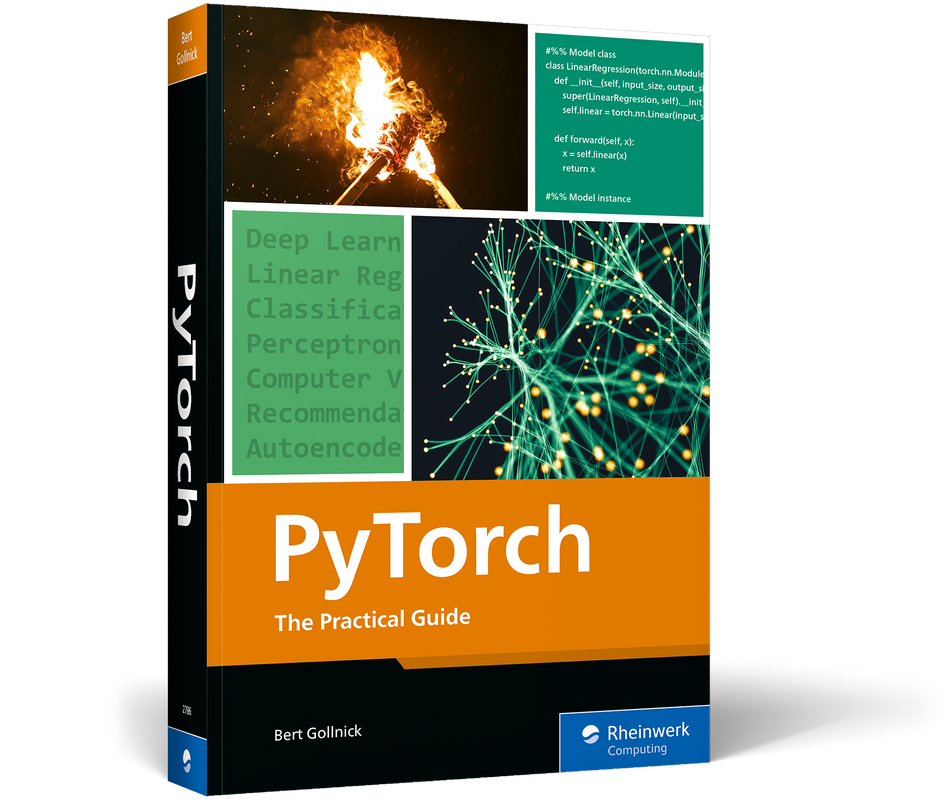
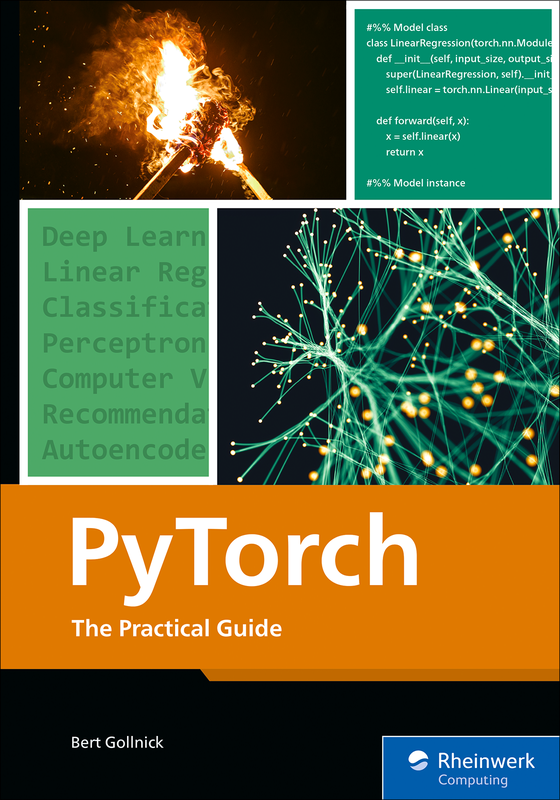
PyTorch The Practical Guide
ISBN 978-1-4932-2786-0 425 pages, 2026
E-book formats: EPUB, PDF, online
ISBN 978-1-4932-2787-7 425 pages, 2026, Print edition paperback
E-book formats: EPUB, PDF, online
ISBN 978-1-4932-2788-4
- Train, tune, and deploy deep learning models with PyTorch
- Implement models for linear regression, classification, computer vision, recommendation systems, and more
- Work with PyTorch Lightning, TensorBoard, LangChain, and FastAPI
In this book, you'll learn about:
-
Theory
Get a thorough grounding in the concepts behind your models. Whether you’re looking to understand how a confusion matrix or ROC curve helps you evaluate a classification model or you want to grasp how recommendation system algorithms function, this guide has got you covered.
-
Practice
Move beyond theory with hands-on exercises and code. Create datasets for your linear regression models, use diffusion to create realistic images from noise, process sequential data with recurrent neural networks, and more.
-
Deployment and Evaluation
Monitor your training process, visualize metrics, and evaluate models with tools like MLflow and TensorBoard. Deploy models on-premise with FastAPI or in the cloud with Heroku.
Highlights include:
-
Deep learning
-
Linear regression
-
Classification
-
Computer vision
-
Recommendation systems
-
Autoencoders
-
Graph neural networks (GNNs)
-
Time series predictions
-
Language models
-
Pretrained networks
-
Evaluation and deployment
-
PyTorch Lightning
You may also like:
-
Applied Machine Learning
450 pages, paperback
Put machine learning theory into practice with this hands-on guide! Learn about the real-world application of machine learning models by following three use cases, each with its own dataset. Get started with tools like GitHub and Anaconda, and then follow … More about the bookapprox. $54.99
Pre-order now
Available on 02/25/2026E-book | Print edition | Bundle -

React –
The Comprehensive Guide676 pages, paperback
React.js makes developing dynamic user interfaces faster and easier than ever. Learn how to get the most out of the library with this comprehensive guide! Start with the basics: what React is and how it works. Then follow practical code … More about the bookfrom $54.99
Available
E-book | Print edition | Bundle -
Machines That Think –
How Artificial Intelligence Works and What It Means for Us255 pages, hardcover
Artificial intelligence is no longer confined to science fiction. It recommends what we watch, curates what we read, and even drafts what we write. Yet for all its influence, AI remains a mystery to many of us. How does it … More about the bookapprox. $24.99
Pre-order now
Available on 01/28/2026E-book | Print edition | Bundle