
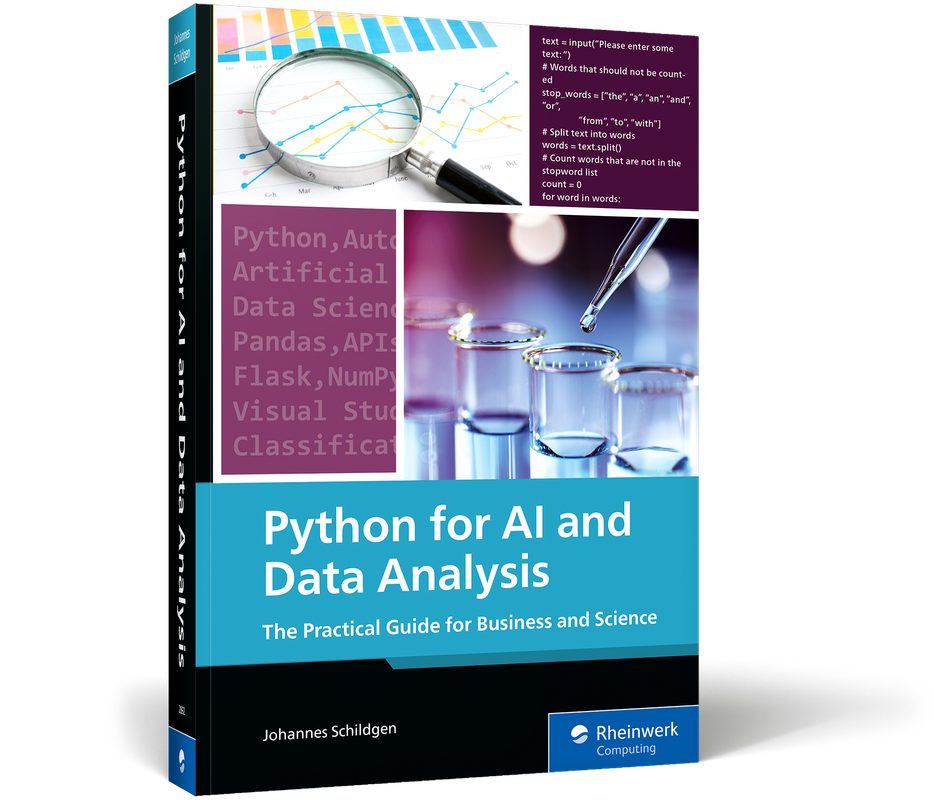
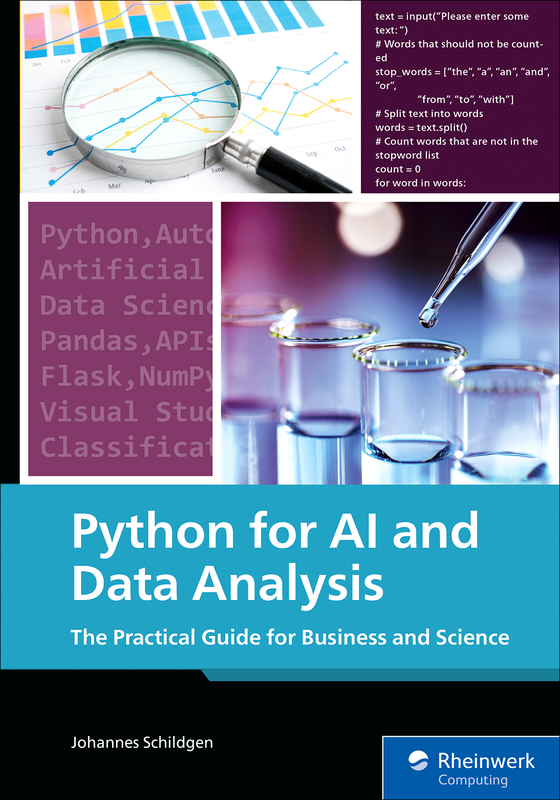

Python for AI and Data Analysis The Practical Guide for Business and Science
ISBN 978-1-4932-2892-8 282 pages, 2026
E-book formats: EPUB, PDF, online
ISBN 978-1-4932-2893-5 282 pages, 2026, Print edition paperback
E-book formats: EPUB, PDF, online
ISBN 978-1-4932-2894-2
- A practical guide to Python for AI and data projects
- Learn to analyze and visualize data with NumPy, pandas, and Matplotlib
- Use AI and machine learning for predictive modeling, text analysis, and image recognition
In this book, you'll learn about:
-
Data Analysis and Visualization
Get hands on with the Python data stack. Use NumPy and pandas to load, clean, filter, and transform data from CSV, Excel, JSON, and other formats. Then turn your results into compelling charts and interactive plots with Matplotlib.
-
Machine Learning and AI
Apply the tools professionals use! Work through classical machine learning methods—linear regression, decision trees, clustering, and more—before moving into natural language processing, sentiment analysis, image classification, and deep learning.
-
Automation and Real-World Applications
Take Python beyond analysis. Build lightweight web tools with Flask and Streamlit, scrape web pages, query databases, and automate recurring tasks—from PDF processing and document generation to scheduled data retrieval and email notifications.
Highlights include:
-
Python fundamentals
-
Data analysis
-
Data visualization
-
Machine learning
-
Natural language processing
-
Text and sentiment analysis
-
Image recognition and classification
-
APIs and web scraping
-
Database access
-
Task automation
You may also like:
-
Intelligent Finance with SAP –
AI-Based Automation and Custom Solutions535 pages, hardcover
You’ve seen the hype around AI—but are you ready to make the most of it? With this book, discover how standard and generative AI can elevate your finance capabilities. Take a tour of SAP’s embedded and service-based AI tools for … More about the bookfrom $84.99
Available
E-book | Print edition | Bundle -

Introducing SAP Datasphere
138 pages
SAP Datasphere is the latest solution for data warehousing—so how does it work, and what can it do for your business? Get an overview of SAP Datasphere and review its integration capabilities. Learn how to use the Data Builder to … More about the book$29.99
Available
E-Bite -
Clean Core for SAP –
Extensibility and Upgrade Stability for SAP S/4HANA429 pages, paperback
Looking to understand the reality behind the “clean core”? Start by understanding the fundamentals of this approach, from standardized extensions and integrations through data management and operations. Then dive into creating custom extensions, following expert guidance each step of the … More about the bookapprox. $74.99
Pre-order now
Available on 09/24/2026E-book | Print edition | Bundle